
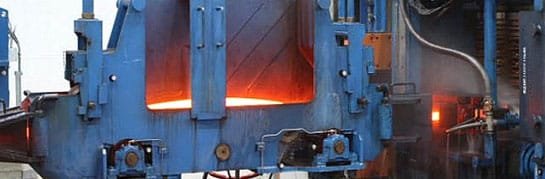
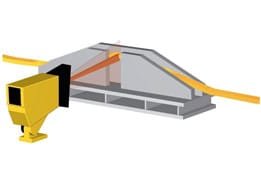

Overview: Vertical loopers, as the name suggests, operate in a vertical orientation to maintain a loop in the strip material. These systems are equipped with advanced automation features and rely on precise electronic sensors, such as loop scanners, to monitor and control the loop size dynamically. Vertical loopers are particularly useful in environments where horizontal space is limited or where specific vertical arrangements are required by the production process.
Functionality: The core component of a vertical looper system is the loop scanner, an advanced electronic device designed to measure the loop size accurately. The scanner works effectively even in challenging conditions, such as environments with steam, fumes, or high temperatures, ensuring reliable performance and optimal loop control.
Advantages:
- Space-Saving: Vertical loopers require minimal horizontal space, making them ideal for compact production lines.
- High Precision: Equipped with automatic sensors, these loopers deliver accurate loop size measurements, ensuring optimal tension control.
- Versatility: They are suitable for wire, rod, and profile mills, including those processing special metals.
- Robust Performance: The use of advanced electronics ensures consistent performance even under harsh industrial conditions.
Applications: Vertical loopers are extensively used in rolling mills dealing with wire, rods, and profiles, particularly where production processes require precise control of loop dimensions and tension.
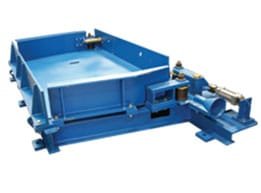
Reviews
There are no reviews yet.